
“Yet in thy dark streets shineth
The everlasting Light;
The hopes and fears of all the years
Are met in thee to-night.”

“O Little Town of Bethlehem”
Words: Phillips Brooks, 1868
Music: Lewis Henry Redner, “St. Louis,” 1868
Ralph Vaughn Williams, “Forest Green,” 1906
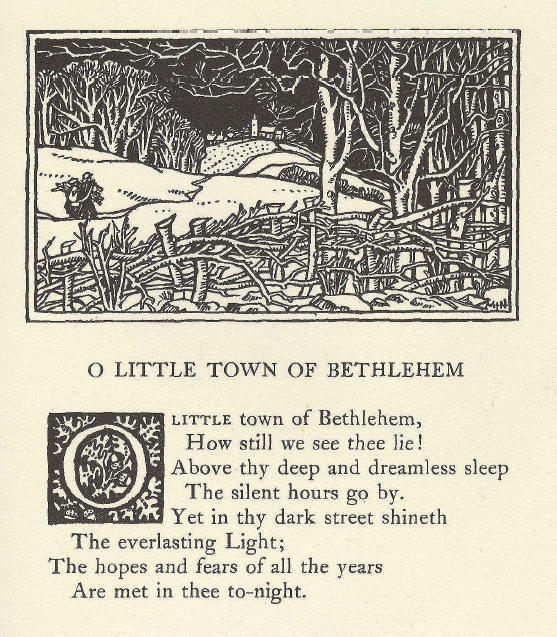
There is something wondrous and tender about this carol. It captures the quiet, still, darkness of the sleepy little town in which the Lord was born as a tiny infant. Appropriately enough the carol was originally written for a Sunday school Christmas service, in 1868. The author, Phillips Brooks, was the rector of a church in Philadelphia. He had a particular fondness for the students in his Sunday school, which comes through in a letter he wrote to them while away on a trip through the Middle East and Europe; he spent Christmas Eve in the Church of the Nativity, in Bethlehem itself; while there, his thoughts turned to his students back home:
I remember especially on Christmas Eve, when I was standing in the old church at Bethlehem, close to the spot where Jesus was born, when the whole church was ringing hour after hour with the splendid hymns of praise to God, how again and again it seemed as if I could hear voices that I knew well, telling each other of the “Wonderful Night” of the Saviour’s birth, as I had heard them a year before; and I assure you I was glad to shut my ears for a while and listen to the more familiar strains that came wandering to me halfway round the world.
Life and Letters of Phillips Brooks, Alexander V. G. Allen, 1900, p. 573
I think there is also something childlike reflected in the carol itself: just as a child is small and yet infinitely precious, Bethlehem, the little town, housed “the everlasting light;” and just as a child is both weak and yet full of potential, the feeble “hopes and fears of all the years” met together in that birth.
The contrast between the insignificance of the setting and the importance of the event echoes the Christmas prophecy of Micah:
But you, Bethlehem Ephrathah,
Micah 5:2
Though you are little among the thousands of Judah,
Yet out of you shall come forth to Me
The One to be Ruler in Israel.
Bethlehem truly was little among the thousands of Judah. Most estimates put its population at fewer than a thousand when Jesus was born there. It is true that it had a reputation as the city of David, the birthplace of the great king; but even in that there is a reminder of smallness: David was the youngest of his brothers, a mere shepherd boy, not someone that anyone expected to be able to take on a giant in battle or to become a warrior-king. And Bethlehem remained a little town, passed over by the world.
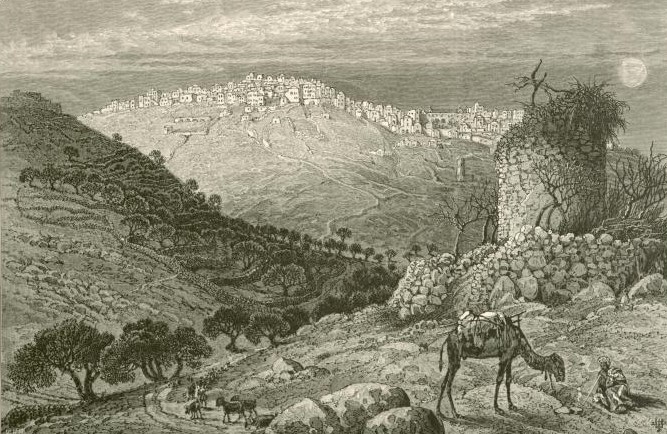
Yet it was into this place that the light first shone. This was not just any light; it was the everlasting light, the light of life, that shone there in the dark streets of Bethlehem. The Doctrines of the New Church tell us that Bethlehem represents the link between what is heavenly and spiritual; and the Lord was born there because unlike any other man He was born having this connection already, a connection between truth in the mind and goodness in the heart (Secrets of Heaven §§4594:2, 6247). In Him, light and life made one. What shone on the outside was inspired from within by the deepest love imaginable.
In a world where reason and intellect are given value, this spiritual truth and goodness can be belittled or disregarded. The Lord came to elevate what was deemed lowly and insignificant into the hope of mankind; to elevate the truth of goodness into prominence over mere knowledge and passions. In the words of Mary,
He has put down the mighty from their thrones, and exalted the lowly.
Luke 1:52
The shifting perception of Bethlehem’s significance reflects this change. The prophecy of Micah is reworded in the Gospel of Matthew: no longer is Bethlehem called “little among the thousands of Judah;” rather it is called “not the least among the rulers of Judah.” Just as the Lord’s holy birth elevated the status of Bethlehem, His life elevated the status of truth and goodness for all to see.
This light shone in the darkness; and although the darkness did not comprehend it, the same light continues to shine through all the years; it is the everlasting light that guides through all our hopes and fears. Its presence may indeed begin small; our connection to heaven may feel feeble and weak; our love may start as a flickering flame, barely alive; our future regeneration may appear tenuous and uncertain; yet in silence, in our smallness and insignificance, and in the dark recesses of our souls, the Lord is at work to impart to us His blessing, working to fill us with truth that will lead to goodness, and with love that will inspire us with truth; just as in secret He was born so long again in the little town of Bethlehem; and what is said of that day may be said of us:
How silently, how silently,
The wondrous gift is given;
So God imparts to human hearts
The blessings of His Heaven.
No ear may hear His coming,
But in this world of sin,
Where meek souls will receive Him still,
The dear Christ enters in.

 New Church Christmas Carols