
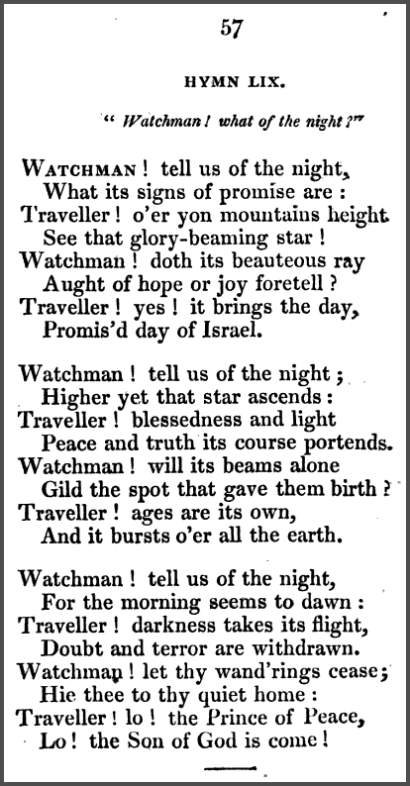
“Watchman tell us of the night,
For the morning seems to dawn.
Traveler, darkness takes its flight,
Doubt and terror are withdrawn.”

“Watchman, Tell Us of the Night”
Words: Sir John Bowring, 1825
Music: Lowell Mason, “Watchman,” 1831
George J. Elvey, “St. George’s Windsor,” 1858
Joseph Parry, “Aberystwyth,” 1879
As with most carols there are many tunes this one is sung to. The one used in the General Church of the New Jerusalem is called “St. George’s Windsor.”[1] It is the same tune as the Thanksgiving hymn “Come, Ye Thankful People, Come.” My favourite version as of late however is a duet by The Walking Roots Band.
This carol is a conversation between a traveler and a watchman. The traveler asks of the night, and the watchman tells of a rising star that portends peace, truth, and the coming of the Son of God. Their conversation ends as the morning dawns and the watchman can withdraw to his home having done his duty through the long watches of the night.
The imagery of a watchman is found in multiple places in the Word, but this carol is most closely associated with Isaiah 21:
He calls to me out of Seir,
Isaiah 21:11-12
“Watchman, what of the night?
Watchman, what of the night?”
The watchman said,
“The morning comes, and also the night.”
This passage is echoed in the opening line of each verse, “Watchman, tell us of the night.” The idea of a traveller inquiring of a watchman of the night speaks of both uncertainty and hope: the uncertainty of what the night brings but the hope that there might be something of light on the horizon.
Truth be told, the image that comes to my mind when I think of a watchman has more to do with the former: someone who warns of approaching danger. That is part of the role; but watchmen are also there to announce the arrival of good news. They not only warn of evil, they also announce what is good. This is perhaps why the watchman of Isaiah answers “the morning comes, and also the night.” Both good and ill are on the horizon.[2]
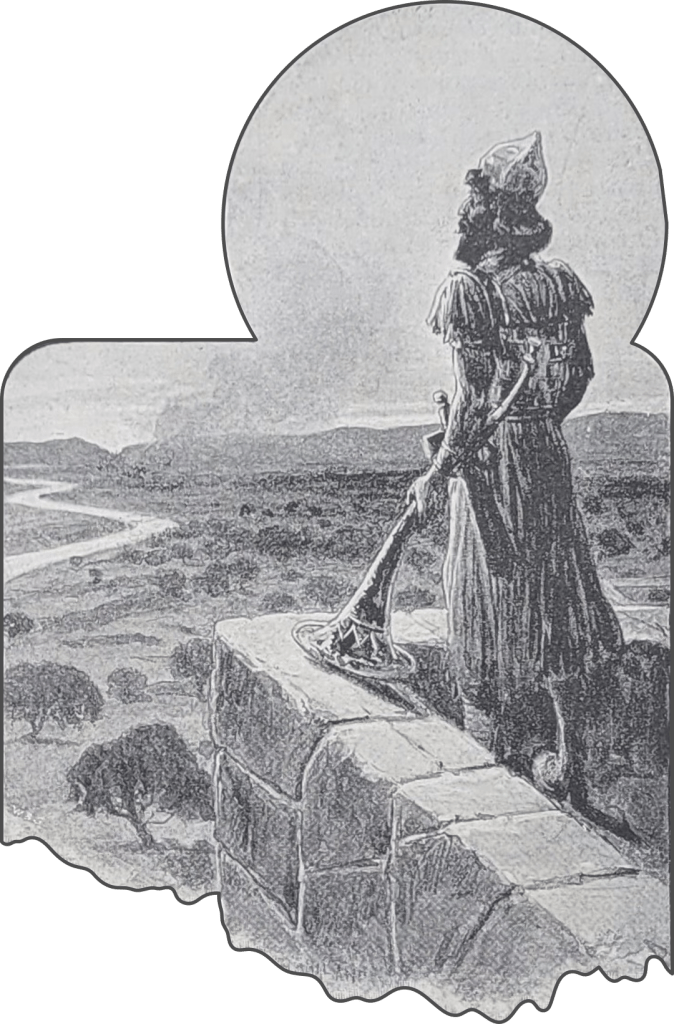
The need for watchmen to warn of danger is important: the world can certainly be a dark landscape of night, spiritually speaking. There is plenty of hardship and sorrow that exists around us. Even in the church there might be strife and confusion, while within ourselves there may exist doubt and ignorance of the Lord’s leading on our own spiritual journeying. We might wonder if there is “aught of joy or hope” foretold, a guiding star portending “blessedness and light, peace and truth.”
There is indeed hope to be found; and it can be found in the Lord’s Word. The Doctrines of the New Church explain that when we turn to the Word in search of the Lord, we are acting as a kind of “watchman:”
“Watchmen” stands for those who search the Scriptures regarding the Lord’s Coming. Their ‘voice’ is the Word, which is Divine Truth, their source.
Arcana Coelestia §9926
As we read the Word, with the intent to discover the Lord, our eyes will be opened to the truths that lead and guide us. We can then act as a watchman for others as well, pointing spiritual travellers and sojourners to the same truths that we have discovered in the Word.
The carol of course focuses on the good tidings of the Lord’s coming. The watchman in it is privileged to be able to read the sign of the star and understand the glorious hope that it represented. Another passage from the Word, again from Isaiah, speaks of the watchmen lifting their voices in joyous song upon observing the coming of the Lord:
How beautiful upon the mountains
Isaiah 52:7-10
Are the feet of him who brings good news,
Who proclaims peace,
Who brings glad tidings of good things,
Who proclaims salvation,
Who says to Zion,
“Your God reigns!”
Your watchmen shall lift up their voices,
With their voices they shall sing together;
For they shall see eye to eye
When the LORD brings back Zion.
Break forth into joy, sing together,
You waste places of Jerusalem!
For the LORD has comforted His people,
He has redeemed Jerusalem.
What a joyful privilege it would be to be one of the first to witness the Lord’s coming! In fact, we can have that privilege: although knowledge of the Word opens our eyes to many worldly dangers and evils, it also opens our eyes to the miraculous things that the Lord can accomplish. It is a privilege to be able to witness even a small portion of the Lord’s Divine Love and Wisdom.
The last verse reminds me strongly of Simeon in the Christmas story. He had been told that he would not see death before he had seen the Lord’s Christ; and so he was led to the temple on the day Jesus was brought there by Mary and Joseph. As promised, Simeon beheld the Lord’s Christ, and even held Him in his arms, saying,
Lord, now You are letting Your servant depart in peace,
Luke 2:29-32
According to Your word;
For my eyes have seen Your salvation
Which You have prepared before the face of all peoples,
A light to bring revelation to the Gentiles,
And the glory of Your people Israel.”
Having watched and waited and at last seen the promised salvation of his people, Simeon could die in peace. He would not live to see Jesus’ adult ministry, nor did he need to; the infant Jesus was enough for him. Likewise the watchman, having seen the first signs of dawn, can withdraw, in full confidence of the coming day. He can let his vigils cease,[3] and go now to his quiet home.
In a world that is so dark, perhaps seeing the first glimmer of dawn can be enough; perhaps seeing the mere beginnings of the Lord’s Advent can suffice to give us hope. The Lord’s Church is not limited to one time or place; and while we might not live to see it, the time will come when the good news of His Advent does indeed “burst o’er all the earth;” and at this dawning, “darkness takes its flight, doubt and terror are withdrawn.”
Footnotes
[1.] In fact the 1995 edition of the liturgy used the tune “Aberystwyth” by Parry. It was changed back in the 2005 edition.
[2.] The spiritual meaning of this pairing of the morning and the night is that a spiritual morning is as enlightenment and salvation to the good but darkness and destruction to the evil (Arcana Coelestia §8211).
[3.] A sensible (IMHO) change was made in the General Church liturgy, from “let thy wand’rings cease” to “let thy vigils cease” in the final verse.

 New Church Christmas Carols