
“Joy to the earth, the Savior reigns;
Let men their songs employ.
While fields and floods, rocks, hills, and plains
Repeat the sounding joy.”

“Joy to the World”
Words: Isaac Watts, 1719
Music: Lowell Mason, “Antioch,” 1848
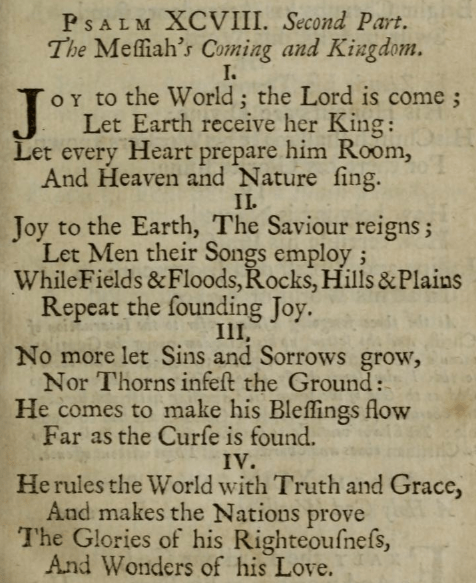
The words of this hymn come verbatim from Isaac Watts. They are also explcitly based on the words of Psalm 98:4-9. Watts had an interesting take on the singing of Psalms in worship: essentially he held that their archaic nature, their context in the individual life of David, and their rootedness in the culture of ancient Israel, rendered them innaccesible to modern Christians. He took it upon himself therefore to reword them in a way that would make them universally relevant and applicable to Christian life and worship. The result was his Psalms of David, Imitated in the Language of the New Testament, and apply’d to the Christian State and Worship. Watts covered most (but not all) of the Psalms, writing them as songs to be sung during worship services.
A sample of the first few lines of the most well-known Psalm should give a feel for Watts’s approach (He actually gives 3 versions of the 23rd Psalm):
The LORD is my shepherd; I shall not want.
Psalm 23:1-2
He maketh me to lie down in green pastures:
he leadeth me beside the still waters.
My Shepherd will supply my Need,
Watts’s Paraphrase
Jehovah is his name;
In Pastures fresh he makes me feed
Beside the living stream.
On the one hand Watts’s paraphrase makes for a poor translation: it alters the literal sense of the Word, and so obscures the spiritual sense. On the other hand, as music and poetry, it is cool to discover that a well-known hymn is based directly on the Word. Watts himself acknowledged something along these lines:
I grant ’tis necessary and proper, that in translating every Part of Scripture for our
Isaac Watts, Psalms of David
Reading or Hearing, the Sense of the Original should be exactly and faithfully represented; for there we learn what God says to us in his Word: But in Singing for the most part the Case is alter’d: For as the greatest Number of the Psalms are devotional, and there the Psalmists express their own personal or national Concerns; so we are taught by their Example what is the chief Design of Psalmody, (vis.) that we should represent our own sense of things in Singing, and address ourselves to God expressing our own Case.
As for “Joy to the World,” it is based on Psalm 98, verses 4 to 9:
Make a joyful noise unto the LORD, all the earth:
Psalm 98:4-9, King James Version
make a loud noise, and rejoice, and sing praise.
Sing unto the LORD with the harp;
with the harp, and the voice of a psalm.
With trumpets and sound of cornet
make a joyful noise before the LORD, the King.
Let the sea roar, and the fulness thereof;
the world, and they that dwell therein.
Let the floods clap their hands:
let the hills be joyful together
Before the LORD;
for he cometh to judge the earth:
with righteousness shall he judge the world,
and the people with equity.
At first glance there is not much Christmas-y about this particular psalm; but spiritually speaking it is directly about Christmas, in other words, about the Lord’s coming, salvation, and the resulting joy. Verses 4-9, the basis of “Joy to the World” focus especially on that joy, and its universal nature. It is not just one part or another of the earth that will rejoice in the Lord, not just a handful of people who will celebrate Him. It is all the earth that makes a noise unto the Lord, and the fulness of the sea and the world, the very floods and hills, that rejoice before Him. It is a picture, as the hymn says, of both “heaven and nature sing[ing]” and “fields and floods, rocks, hills, and plains, repeat[ing] the sounding joy” of all people.
The widespread joy at the Lord’s coming is found throughout the Christmas story, particularly in the story of the shepherds. They were told by the angel,
Do not be afraid, for behold, I bring you good tidings of great joy which will be to all people. For there is born to you this day in the city of David a Savior, who is Christ the Lord.
Luke 2:10-11
The good tidings were not just for the shepherds, but for all people. Nor did the shepherds keep the good tidings to themselves, but rather spread them far and wide to all who would listen:
And when they had seen it, they made known abroad the saying which was told them concerning this child. And all they that heard it wondered at those things which were told them by the shepherds.
Luke 2:17-18
This was no earthly or natural joy, but a spiritual one. All of those elements of nature and men, of heaven and earth, represent all the different parts of the church: understanding and knowledge, goodness and truth, love and wisdom. What’s more, these things, when they are genuinely from heaven, are the one true source of joy with a person:
All these things are said “to sing,” “to break forth,” “to shout for joy,” “to cry aloud,” and “to clap the hands,” when they are from heaven, for then heavenly joy is in them, and through them in man; for man is not in heavenly joy unless the things in him, which are truths and goods, are from heaven; from these is joy of heart that is truly joy, and from these is the joy of the man with whom they are.
Apocalypse Explained 326
For all that we might seek joy in earhtly things, joy only enters the world from heaven. If it is not from heaven than it is only a passing or shallow thing.
What’s striking to me though is why there was such joy at the Lord’s birth: it was not just that He had come to earth, but that He had been born “a Saviour, who is Christ the Lord.” Jesus did not just come into the world to share joy by His presence but to literally save people from sin and hell. There is an echo of this idea in Watts’ second verse: while the first begins, “Joy to the World, the Lord is come,” the second begins, “Joy to the Earth, the Savior reigns.” Without that Saviour and the salvation He brought there could not be any of the joy. The one follows the other. The celebration of salvation is in fact said to be the source of singing in the Word:
From these words also it is evident that a “song” denotes a glorification of the Lord on account of liberation; for the songs involved gladness of heart, and the exaltation of the Lord-gladness of heart, on account of the Lord’s coming and salvation then; and exaltation, on account of victory over spiritual enemies. Gladness of heart with exaltation of the Lord is what is meant by glorification.
Arcana Coelestia 8261
As we experience the joys of the Christmas season perhaps our joy can be deepened by reflection on what the Lord actually accomplished, and indeed, on the salvation that He continues to accomplish in our own lives. Watts leans into the theme of salvation by including a verse on the infestation of sin, a concept not found in the original Psalm:
No more let sin and sorrow grow,
Nor thorns infest the ground:
He comes to make His blessings flow
Far as the curse is found.
Where once the curse of sin infested the ground the Lord’s blessings can flow through repantance and subsequent salvation. Where once selfishness had taken root, the glories of the Lord’s righteouesness and wonders of His love can reign. This is the joy of Christmas. So “let every heart prepare Him room, and heaven and nature sing” for all that He has done for us, and for all that He does still.

 New Church Christmas Carols